
Skip to main content Skip to search

Your Mortgage Journey Made Simple

Your Mortgage Journey Made Simple

Navigating the Irish Property Market: The Complete Mortgage Guide

Welcome to this comprehensive guide on navigating the property market, based on the insights provided in the Piccadilly Mortgages presentation. Whether you are a first-time buyer or looking to switch lenders, this guide covers everything you need to know about securing your mortgage and dream home.

About Piccadilly Mortgages

Piccadilly Mortgages is a local mortgage broker based in Dublin city centre, serving clients nationwide. Led by Brokerage Owner Tracy O’Sullivan and Head of Governance Francesco Di Napoli, their goal is to provide independent support and offer a practical overview of mortgage rules, incentives, approvals, rates, and costs.

1. The Role of a Mortgage Broker

A mortgage broker partners with you throughout your full mortgage journey rather than operating purely as a transactional service.

What They Do

  • Work with MULTIPLE BANKS on your behalf (typically around 9 different lenders) to find the most suitable terms.
  • ADVOCATE for you: if issues arise, brokers develop workaround solutions.
  • PARTNER with you through the full journey: application, house hunting, interest rate selection, and closing.

Why Use a Broker?

  • Choice: Access to more banks, products, and interest rates for the biggest purchase of your life.
  • Expert Advice: Brokers specialize purely in mortgages daily, offering higher expertise and experience.
  • Enhanced Service: Direct connections to key network professionals, including solicitors, valuers, snaggers, surveyors, and life protection experts.

2. Borrowing Power & Your Leverage

Your borrowing capacity is guided by Central Bank of Ireland rules (not individual bank rules). Standard limits allow First-Time Buyers (FTB) to borrow up to 4 times annual salary, while Second-Time Buyers (STB) can borrow up to 3.5 times. The standard deposit requirement is 10%.

Understanding Exceptions

  • Banks can sometimes offer MORE than standard income limits (e.g., up to 5x income for FTBs with certain lenders).
  • Exceptions are NOT guaranteed and are capped annually by the Central Bank of Ireland.

Leveraging Variable & Extra Income

Each bank evaluates extra or non-guaranteed income differently. Using your variable income strategically can significantly boost your total borrowing capacity.

Income Type Bank Treatment & Policies
Overtime e.g. Bankinter SA T/A Avant Money. will take 75% over your average overtime over the last 3 years but only 60% of your bonus income. For example, in the health sector where overtime is often a normal part of their role, some banks can take all of this into account if regular/guaranteed.
Bonus Each bank takes a different amount of your bonus into account. Some banks also require that you are in your job for 3 years before they will consider your bonus income. But others can be different.

For example: BOI normally takes around 50% of the average gross bonus over the last 3 years. NUA Money can potentially take up to 90% of your bonus after a year or two.

On Call Treated like overtime (guaranteed vs. non-guaranteed).
Commission Treated similarly to bonus income; banks accept 50%, 60%, or up to 75%.
Stock (RSUs) Most banks do not take this into account. Some do but they can charge you a higher interest rate for this.

For example: Haven Mortgages (AIB’s broker arm) can take up to 50% of your vested RSUs into account (ideally after 3 years & 3 EDSs) – they are strict in terms of the confirmation of what they require from your employer.

NUA Money can potentially take up to 75% after a year.

BOI, PTSB and Bankinter SA T/A Avant Money. do not take stock income into account.

Public Sector Pay Scale Some banks take future income into account e.g. 1 or 2 or 3 points above the current pay scale. One bank (ICS Mortgages) can even go up to 5 points, but they will charge you a higher interest rate for this.
Allowances Car allowances counted at 100%. Health allowances accepted by BOI and MoCo.
Other Income Children’s Allowance accepted by select banks. PTSB & NUA Money accept Maintenance. Social Welfare depends on the type but in certain situations it can be by certain banks.

IMPORTANT: Employers must explicitly confirm all variable income details on your official Salary Certificate.

Real-World Leverage Examples

  • Example 1: Married couple (both 35, 2 kids, 1 income FTB, €75k base + €30k bonus + €15k stock). NUA Money offers €475,000 vs. PTSB’s €360,000 (a €115,000 increase) because NUA considers stock, Children’s Allowance, and a higher bonus percentage.
  • Example 2: Single FTB (30, €50,000 salary + €2,500 Health Allowance + €50,000 commission after 1 year). NUA Money offers €317,000 vs. BOI’s €210,000 (a €107,000 difference) because NUA accepts 1-year commission history (BOI requires 3 years). After 2 years, NUA capacity rises to €380,000.
  • Example 3: Hospital doctor on rolling temporary contract (€73,399 salary + high overtime). ICS offers €459,000 vs. BOI’s €353,000 (a €106,000 difference) because ICS counts 100% of last year’s overtime while BOI strictly averages 3 years for non-permanent staff.

3. Buyer Incentives

Buyer Incentives

  • Help to Buy (HTB) Scheme: You can get up to 30k from Revenue to go towards the deposit. However, this is based on the tax that you have paid over the last 4 calendar years. You must apply through Revenue for this. HTB Maximum price of a qualifying property is €500,000.
  • First Home Scheme If you don’t qualify for enough of a mortgage the First Home Scheme can fund the gap of up to 30% of the purchase price.
    • You must contribute at least 10% of the purchase price yourself.
    • You can use the HTB + FHS together, however if you do then the maximum FHS amount is reduced to 20% of the purchase price.
    • This is normally for new build properties, however there is one exception and that is where you are buying the house that you are renting.
    • You must obtain mortgage approval form a bank that is part of the First Home Scheme. The main traditional lenders are for example; AIB, PTSB, Bank of Ireland. You will not be able to use a non-traditional/non-retail lender if you also want to use the FHS scheme e.g. NUA Money.
    • It is best to obtain your mortgage approval first, then go to the First Home Scheme.
    • FHS Maximum price of a qualifying property is €500,000 in Dublin and reduces in other areas outside Dublin.
  • Vacant Property Grant: You can get up to 50k. Property needs to be vacant for 2 years (electricity records can be check to confirm this). Most banks prefer you purchase the house first i.e. they will not consider the 50k as part of your deposit.
  • Affordable Purchase Scheme (FTB & New Build house only)
    • Each local authority will sell newly built homes (in their own local area) at a price lower than the open market value.
    • You can use the Help to Buy scheme. You cannot use the First Home scheme.
    • An affordable home will have a minimum purchase price set by the local authority. You must be able to show that you have the capacity to pay at least the minimum purchase price by using a combination of a mortgage, savings and Help to Buy (if applicable).
    • The price you pay for your home will be higher if your income and mortgage capacity is higher.
    • The shortfall in funding will be covered by the Affordable Housing Scheme and this shortfall will be deemed as a % equity share of your property. If you sell your property, the equity share will have to be paid back.
    • You have the option of buying back your equity share over time, if you wish.
  • There are two types of mortgages that you can use for an Affordable Purchase Scheme house:
    • 1. Mortgage approval from a traditional/retail bank that is part of the Affordable Purchase Scheme e.g. Bank of Ireland, AIB, PTSB, EBS.
    • 2. A local authority home loan – https://localauthorityhomeloan.ie/

    Currently people have more interest rate options with a traditional lender.

Who Qualifies as a First-Time Buyer?

The BANKS class person is a first-time buyer in the following two scenarios:

  1. Never Held a Mortgage – A person has never held a mortgage in Ireland or outside Ireland. You may own or have an interest in a property in Ireland or outside Ireland, however if there is/was never a mortgage on the property, the banks will class you as a first-time buyer and first-time buyer lending rules apply.
  2. Fresh Start Principle – Applicant(s) who previously purchased or built a dwelling with a spouse, a civil partner or a person with whom they were in a committed relationship with where the relationship has ended, and they have divested themselves of their interest in the previous dwelling. This also applies to applicants where they have been through and exited insolvency or bankruptcy proceedings, however a separate assessment of creditworthiness is applied in these circumstances.

The Help to Buy Scheme, First Home Scheme & Affordable Housing Scheme class a person as a first-time buyer as follows:

  1. Never Held a Mortgage & Never bought a property – A person has never held a mortgage in Ireland or outside Ireland AND who never purchased or built a property outright with cash and is not beneficially entitled to an estate or interest in, any dwelling in the Ireland or elsewhere*. *The Help to Buy Scheme advises that if you have inherited, or have been gifted, a property, depending on the circumstances, it may not affect your eligibility.
  2. Fresh Start Principle – applies generally but on a case-by-case scenario depending on the circumstances.

4. Getting Approval in Principle (AIP)

An Approval in Principle (AIP) is an official A4 document from the bank confirming your maximum borrowing limit, demonstrating to estate agents that you are mortgage-ready.

Step 1: Preparation

  • Demonstrate repayment capacity and affordability over the previous 6 months.
  • Keep bank accounts simple: minimize third-party transfers.
  • Show stable salary deposits, timely bill payments, and consistent savings.

Step 2: Submission

  • Speak with your broker or bank and complete the application online or in person.
  • Provide background explanations for large transfers, job history, or past credit issues.
  • Provide clear proof of your 10% deposit (savings, HTB, or gift letters — future savings are not accepted).
  • Review the full document checklist at: Piccadilly Mortgages Document Checklist.
  • Upload documents and wait for the bank response.
  • AIP decisions typically take between 2 business days and 2 weeks.

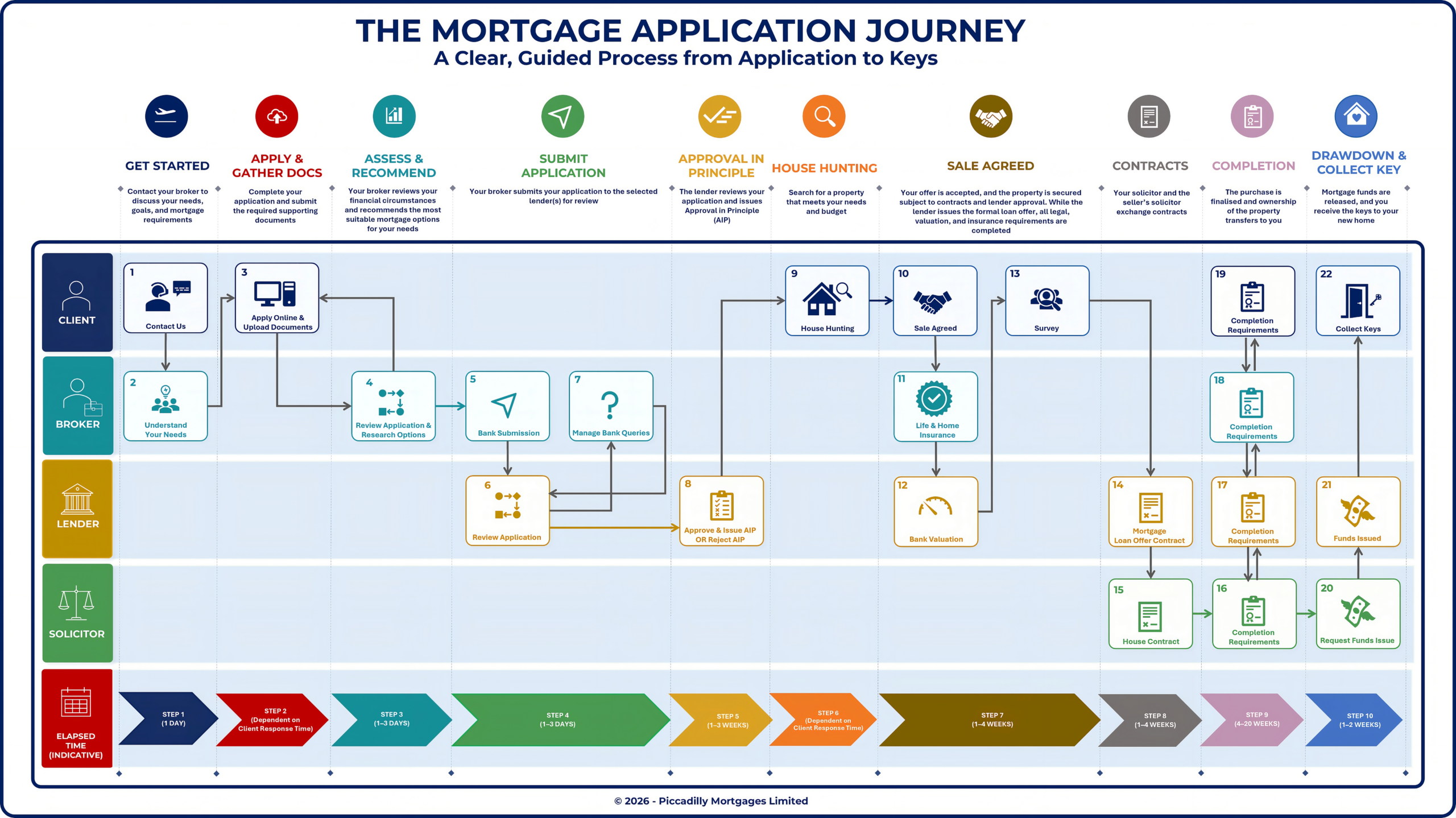
5. The Purchase Process After AIP

  1. House Hunting: Register on daft.ie, myhome.ie, and new build developments. Bid within budget. Upon winning, place a booking deposit (~€5,000–€12,000) to go “Sale Agreed”, Advise your broker or bank.
  2. Contract Stage: Your Solicitor requires two contracts: House contract from the vendor’s solicitor & Mortgage contract from the bank. You will Pay the full 10% deposit (minus booking deposit). Contracts become legally binding upon signing contracts (normally 2 – 4 weeks before the purchase of a second hand property, much earlier for a new build property, often 21 days on receipt of the contract).When contracts are signed and exchanged with the other side (and you have paid your 10% deposit), you will NOT get your money back if you change your mind at this stage because you will be contractually bound to this purchase.
  3. Completion & Keys: Solicitor sets a closing date, draws down bank funds ~2 days prior, and transfers remaining balance. Keys are handed over, and mortgage repayments begin ~1 month later.

6. Estimated Costs Breakdown

Stage Associated Costs
AIP Stage Bank Fee: €0. Broker Fee: SOME brokers can charge. Piccadilly Mortgages does not charge. Your BROKER will advise you UPFRONT if they charge, there will be NO hidden charges.
Contract Stage Valuation Fee: ~€200. Structural Survey: ~€500+ (depending on the size of the property). Contract deposit balance (10% total minus booking you already paid).
Closing Stage Legal Fees: ~€2,500. Stamp Duty: 1% up to €1m purchase price. Remaining purchase balance.

Ongoing Outgoings: Monthly mortgage repayment, Mortgage Protection / Life Cover, Home Insurance, Local Property Tax (LPT), and Management Company Fees (if applicable).

7. Interest Rates & Switching Options

Can you save money if you switch your mortgage?

Switching Lenders

First check what your current bank offers (quickest, zero cost). If exploring external lenders when your fixed rate expires, weigh potential savings against switching costs: Legal (~€1,500–€2,000), Valuation (~€200), and BER Certificate (~€200–€300).

When it may be worth exploring

  • When your fixed rate is expiring.
  • When there is a meaningful rate difference available elsewhere. If there is not perhaps it is cheaper to stay with your own bank for say another 2 years where you do not have any costs. You can then review the market again in two years.

Costs to weigh up

  • Legal fees: about €1,500–€2,000
  • Bank valuation fee: about €200
  • Possibly an updated BER certificate: about €200–€300
  • Your time required to gather documents and reapply

Best Available Rates (As of 30th June 2026)

  • Lowest Fixed Rate: 3.0%
  • Lowest Variable Rate: 3.70%
  • 30-Year Fixed Rate Option: 3.4%

Note: Subject to Loan-to-Value (LTV) ratios and qualification criteria.

Frequently Asked Questions (FAQ)

How do mortgage brokers get paid?
▼ Click to View

Mortgage brokers are paid a commission directly by lending institutions upon drawdown. While some brokers charge additional client fees, Piccadilly Mortgages charges €0 in upfront or hidden broker fees.

How much deposit do I need?
▼ Click to View

The Central Bank of Ireland mandates a minimum 10% deposit of the property purchase price for both First-Time Buyers and Second-Time Buyers.

What affects the interest rate I receive?
▼ Click to View

Interest rates depend on your Loan-to-Value (LTV) ratio, whether you select a fixed or variable product, property BER energy rating (green rates), and lender specific pricing tiers.

Can gifts or loans from friends be used towards a deposit?
▼ Click to View

Gifted funds from immediate family are widely accepted provided a signed gift letter confirms non-repayment. Personal loans or borrowed money from friends cannot be used as deposit equity.

How long does mortgage approval (AIP) take?
▼ Click to View

Once all required paperwork is submitted, receiving your official Approval in Principle (AIP) typically takes between 2 business days and 2 weeks depending on bank queues.

How long does the purchase process take after going Sale Agreed?
▼ Click to View

For second-hand properties, contract signing to key collection usually takes 2 to 4 weeks. For new builds, contract signing often happens within 21 days, with drawdown occurring upon build completion.

When do monthly repayments start?
▼ Click to View

Your first monthly mortgage repayment generally begins approximately one month after loan drawdown and key handover.

How long do I need to be in my job to apply?
▼ Click to View

Most banks require you to have completed your employment probation period. Specific lenders accept contract workers (such as healthcare staff or IT consultants) under specialized policies.

Can crypto, stock, or shares count as savings?
▼ Click to View

Vested stocks and RSUs can be considered by select lenders (e.g., Haven or NUA Money). Crypto assets are heavily scrutinized, and banks require deposit funds to be liquidated into cash in a regulated bank account.

Can I keep my existing personal loans?
▼ Click to View

Yes, but ongoing loan repayments directly reduce your net monthly disposable income, which lowers your total borrowing limit. Clearing short-term debt prior to applying often maximizes borrowing power.

Legal Disclaimer: Piccadilly Mortgages is regulated by the Central Bank of Ireland. The information contained in this guide is provided for general informational purposes only and does not constitute formal financial or legal advice. Individual lending terms, income calculations, and scheme eligibility are subject to underwriting criteria and policy changes by individual financial institutions. Rates referenced are accurate as of 30th June 2026.